Books by Theodore Jerome Cohen
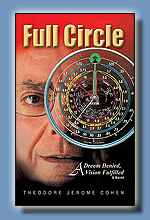
In the end, there emerges the essence of redemption as Teddy returns to the violin late in life and fulfills his and his father’s vision. The story, which is a work of fiction based on real events, will fascinate readers from ages ten to one hundred who are interested in radio, communications, and music and in how it was to grow up in a family whose members trace their heritage to that great wave of immigrants that crashed onto America’s shores in the
mid- to late 1800s.

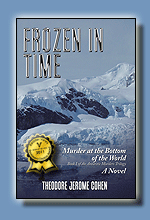
But who can Stone trust with this information, if it comes to that, to see justice done? This story is a work of fiction based on real events that took place between 1958 and 1965. It is a tale of greed, betrayal, and murder—one in which the reader is given a window into the frozen world at the bottom of the Earth that few people ever will read about, much less experience. Among other things, it explores why, though seemingly unfair, bad things happen to good people; how the battle between good and evil can change forever even the most innocent person; and most of all, the role deception plays in Nature, Man, and Life.
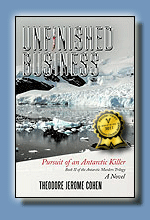
The story of the theft and murders that followed is told in Book I: Frozen in Time: Murder at the Bottom of the World. Unfinished Business introduces Captain Mateo Valderas and Lieutenant-Commander Antonio Del Río of the Chilean Navy’s Office of Internal Affairs. They have been sent to Arica, Chile, where the Lientur is undergoing repairs, to solve a murder that took place on the naval base. Their investigations uncover evidence that leads them to someone who is determined to settle old scores and wrap up ‘unfinished business’ on two continents—South America and Antarctica.
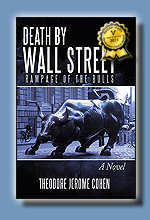
When the severed head of a Wall Street stock analyst turns up spiked on a horn of the Wall Street Bull, Detective Louis Martelli of the NYPD is assigned to track down the murderer. But why were this victim and the victims of two similar murders that followed singled out for execution? Martelli eventually learns the answer to this question and tracks down the killer, but not before uncovering some of Wall Street’s and the US government’s darkest secrets pertaining to the US financial markets and the nation’s health care practices.
The screenplay for this book is available in paperback format.
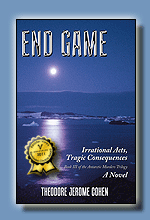
The return of American scientists Ted Stone and Grant Morris to Santiago for the purpose of helping personnel of the University of Chile prepare for the 20th Chilean Expedition to the Antarctic, beginning in December 1965, jeopardizes the lives of both scientists. What 'irrational act' will elicit the tragic consequences that finally bring everything to an end? This answer and more is in Book III: End Game: Irrational Acts, Tragic Consequences.
House of Cards has received a Reader Views Literary Award.
Second place in the 2012 category: Societal Issues (Politics/Society/Etc)

When a man dressed in a long priest's robe and wearing a black, low-crowned, wide-brimmed ecclesiastical hat walked into a Catholic church just prior to the start of a funeral service, stuffed garlic into the deceased's mouth and pumped a bullet into the corpse, NYPD Homicide Detective Louis Martelli is as puzzled as he's ever been on a case. No stranger to the macabre, Martelli is even more mystified by Deputy Coroner Michael Antonetti's findings, which confirm that the deceased, far from having died of respiratory failure and a possible heart attack, was murdered by someone who injected him with a lethal dose of Philippine Cobra venom. When other, similar deaths are uncovered in and around New York City, the investigation conducted by Martelli and his partner, Detective Sean O'Keeffe, takes a decidedly morbid turn, leading to the discovery of a modern-day vampire cult, a woman named 'Lilith,' and a serial killer with a score to settle. Who is behind the killings, and can Martelli and O'Keeffe stop him before he kills his last victim and makes good his escape? The answers to these and other questions will be found in this gripping, modern-day tale of vampirism unlike any you have read.

When a wealthy Wall Street commodity futures trader is found dead in his townhouse of an apparent drug overdose, Deputy Coroner Michael Antonetti, NYPD, is suspicious. Antonetti tells Detective Louis Martelli he suspects what appears to be a suicide may in fact be murder. After a similar case is discovered involving a former friend of the Wall Street trader who played on the same high school football team almost twenty years earlier, Martelli is convinced he is dealing with someone bent on revenge. But the two teammates who ostensibly committed suicide were part of an elite three-man squad known as The Flying Horsemen. This convinces Martelli there will be a third victim. But who might it be, and could the killings have anything to do with the rape and suicide of some of the men's former high school classmates? The answers will be found in this mystery/thriller that will keep you on the edge of your seat until the very end.
(Adult language)
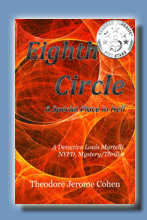
When the mayor of New York City's grandson and the grandson's wife are murdered execution-style in their Tribeca apartment, NYPD Detective Louis Martelli and his partner, Detective Sean O'Keeffe, are left completely in the dark. Months go by without any actionable leads until a meeting with the wife's doctor and the bizarre torching of Stephanie Martelli's car turns the investigation upside down and land Martelli and O'Keeffe in the hotseat. When an old friend of Pietro Martelli, Louis's deceased father and a former street cop who had been gunned down in the line of duty, sends Martelli a note asking for a meeting, things take an even stranger turn. The evidence in this mob-driven case of political corruption, bribery, and murder pits the two detectives against their boss, Captain Hanlon, NYPD Commissioner of Police Eugene Fields, and His Honor the Mayor. Can Martelli and O'Keeffe survive this kind of pressure and keep their jobs, much less solve the case? You'll have to read Eighth Circle to learn the answers.
(Adult language)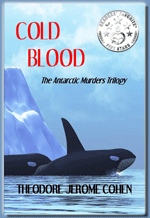
Now, for the first time, the three books that comprise The Antarctic Murders Trilogy:
Frozen In Time,
Unfinished Business, and
End Game
are available in one volume: Cold Blood . . . the Antarctic Murders Trilogy
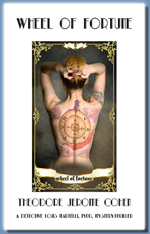
Even as a child, Katlyn Lundquist was drop-dead gorgeous. She also was willful. In her teens, perhaps out of spite, she created her own name and persona. As she grew up, she readily accepted money and gifts from her parents but thumbed her nose at society in general and her parent's way of life in particular. A seeming infatuation with Tommie Lupinacci, head of a major crime-infested cartage association based in Brooklyn, led her to move east with the mobster. But when she showed up dead with a bullet in the back of her head, NYPD Detectives Louis Martelli and Sean O'Keeffe were stumped. If this were a mob hit, why dump her body in plain sight? Moreover, who was she and what was the motive for killing her? The investigation leads to the area around Lundquist's hometown in eastern Pennsylvania and to the mob's efforts to take over the trash hauling and recycling business in Lancaster and York, PA. It's only after Martelli brings IT Specialist Missy Dugan into the case that he and O'Keeffe are able to unravel the mystery.
(Adult language)
Beginning in 2010, and for five years thereafter, the author penned several books, six to be exact, which are referred to as the Detective Louis “Lou” Martelli, NYPD, mystery/thriller series. They feature, as the protagonist, a veteran of the first Iraqi War who lost a leg when the Black Hawk helicopter on which he was the crew chief was shot down during the assault on that nation’s capital. Under a special dispensation given to him by the mayor of New York City, and because his father had been a former street cop, Martelli was allowed to “sit” the exam for detective, which he passed.
We first encounter him as a homicide detective investigating the horrific death of a Wall Street analyst, whose severed head is found spiked to the Wall Street Bull in New York’s Financial District. Other books in the series explore homicides tied to the financial collapse of 2008, corruption in New York City, real-life vampire cults, teen suicide. New York political corruption, and a New York mob’s efforts to take over the trash hauling and recycling business in Lancaster, Pennsylvania . . . all stories based on real-life, so much so that some readers have difficulty separating fact from fiction!
This volume includes a heady mixture of 23 stories and flash fiction tales, along with an introduction to the six novels. Consider it a "Martelli Sampler", and like a box of chocolates, you never know what burst of flavor awaits you next. Enjoy the ride! But be warned, you may not be able to stop yourself from continuing through the other books.
The Road Less Taken
A collection of unusual stories, vividly brought to life in this first book-length assemblage of sojourns into the unexpected by master storyteller Theodore Jerome Cohen.
The Road Less Taken - Book 2
A collection of unusual stories, vividly brought to life in this SECOND book-length assemblage of sojourns into the unexpected by master storyteller Theodore Jerome Cohen.
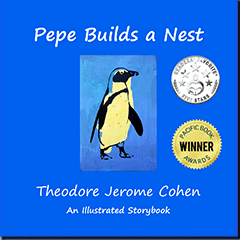
Pepe Builds a Nest
Illustrated Children's Storybook. A wonderful story about making the right choices and dealing with bullies!
Now available in Spanish, French and Italian language editions.
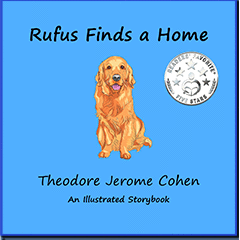
Rufus Finds a Home
Illustrated Children's Storybook. A wonderful story about feelings, compassion, and caring for others, be they humans or animals!
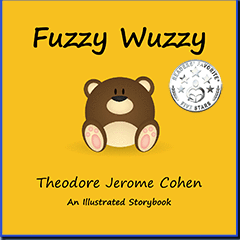
Fuzzy Wuzzy
Illustrated Children's Storybook. An exciting story about a precocious bear cub who doesn't listen to his mother and almost ends up in the hands of the Big Bad Wolf!
Creative Ink, Flashy Fiction Volumes 1-6
If you like your fiction entwined with fact (faction), these collections of "flash fiction" (less than 250 words per story) are for you! Many of the stories featured here were award-winning entries in the weekly Website Indies Unlimited. Other tales were inspired by or drawn from the short stories found in Cohen's The Road Less Taken: A Collection of Unusual Short Stories, Books 1 and 2, or from some of his mystery/thrillers.

Flash Fiction for Animal Lovers
Who doesn't like a good animal story?! That's why we created this special edition for our series on Flash Fiction. The contents of this seventh Flash Fiction anthology are drawn from the 438 stories found in Books 1 through 6, incl., of the Creative Ink, Flashy Fiction anthologies and are devoted entirely to our friends from the Animal Kingdom.
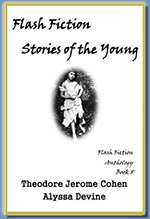
Flash Fiction Stories of the Young
This anthology comprises 73 stories related to childhood selected from the 438 stories found in Books 1 through 6, incl., of the Creative Ink, Flashy Fiction anthologies. The stories, each 250 words or fewer in length, are best compared to a handful of peanuts or M&M's. Which is to say, they're tiny, bite-sized morsels that won't let you stop with one!
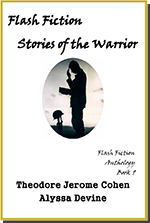
Flash Fiction Stories of the Warrior
Plato said, "Only the dead have seen the end of war." Lending credence to his words are the 56 stories here about Warriors and others involved in battles from our Civil War through the wars in Afghanistan and Iraq. The tales primarily were selected from among the 438 stories found in Books 1 through 6, incl., of the authors' Creative Ink, Flashy Fiction anthologies. Included, as well, are selected offerings from Cohen's two short-story anthologies, The Road Less Taken, as well as stories from Cohen's Mementos series of anthologies. Most of the stories in this volume are 250 words or fewer in length.

Flash Fiction Stories with a Feminine Twist
"Jennifer Zeynab Joukhadar (The Map of Salt and Stars) said: "I am a woman and a warrior. If you think I can't be both, you've been lied to." Lending credence to her words are the 57 stories here about the infinite faces of womanhood. The tales primarily were selected from among the 438 stories found in Books 1 through 6, incl., of the authors' Creative Ink, Flashy Fiction anthologies. Included, as well, are selected offerings from Cohen's two short-story anthologies, The Road Less Taken, as well as stories from Cohen's Mementos series of anthologies. Most of the stories in the instant volume are 250 words or fewer in length. They are best compared to a handful of peanuts or M&M's. Which is to say, they're tiny, bite-sized morsels that won’t let you stop with one! The longer tales were added for those who seek something more substantial with which to curl up on a long winter night or better, on a beach in the hot summer sun.
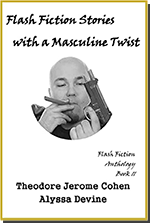
Flash Fiction Stories With a Masculine Twist
Plato said: "Death is not the worst that can happen to men." Lending credence to his words are the 62 stories here about the infinite faces of manhood. The tales primarily were selected from among the 438 stories found in Books 1 through 6, incl., of the authors’ Creative Ink, Flashy Fiction anthologies. Included, as well, are selected offerings from Cohen's two short-story anthologies, The Road Less Taken, as well as stories from Cohen's Mementos series of anthologies. Most of the stories in the instant volume are 250 words or fewer in length. They are best compared to a handful of peanuts or M&M’s. Which is to say, they’re tiny, bite-sized morsels that won't let you stop with one! The longer tales were added for those who seek something more substantial with which to curl up on a long winter night or better, on a beach in the hot summer sun.
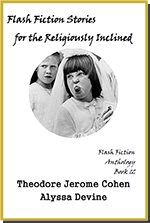
Flash Fiction Stories for the Religiously Inclined
Perhaps the best indication that God has a sense of humor is that He created man in His image (Genesis 1:27). Lending credence to these words are many of the 47 stories here about the infinite faces of the religiously inclined among us. The tales primarily were selected from among the 438 stories found in Books 1 through 6, incl., of the authors' Creative Ink, Flashy Fiction anthologies. Included, as well, are selected offerings from Cohen's two short-story anthologies, The Road Less Taken, as well as stories from Cohen’s Mementos series of anthologies. Most of the stories in the instant volume are 250 words or fewer in length. They are best compared to a handful of peanuts or M&M’s. Which is to say, they’re tiny, bite-sized morsels that won’t let you stop with one! The longer tales were added for those who seek something more substantial with which to curl up on a long winter night or better, on a beach in the hot summer sun.
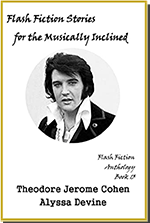
Flash Fiction Stories for the Musically Inclined
Plato said: "Music gives a soul to the universe, wings to the mind, flight to the imagination, and life to everything." Lending credence to these words are the 32 stories here—focused on everything from rock-'n'-roll to jazz and classical to country—that speak to the infinite faces of the musically inclined among us. Unlike the earlier books in the flash fiction series, in which the tales were selected from among the 438 stories found in Books 1 through 6, incl., of the authors' Creative Ink, Flashy Fiction anthologies, augmented with selected offerings from Cohen’s two short-story anthologies, The Road Less Taken, as well as stories from Cohen's Mementos series of anthologies, this book is unique because the stories were inspired by photographic prompts often related to musical themes. As well, included here are excerpts adapted from some of the authors’ more popular novels having relevance to one musical genre or another.
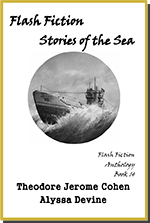
Flash Fiction Stories of the Sea
Jacques Yves Cousteau said: "The sea, once it casts its spell, holds one in its net of wonder forever." Lending credence to these words are many of the 27 stories here about the sea and its impact on humankind. Unlike the earlier books in the flash fiction series, in which the tales were selected from among the 438 stories found in Books 1 through 6, incl., of the authors' Creative Ink, Flashy Fiction anthologies, augmented with selected offerings from Cohen's two short-story anthologies, The Road Less Taken, as well as stories from Cohen's Mementos series of anthologies, this book is unique because the stories were inspired by photographic prompts related to the sea, the men and women who sail them, and the creatures found there. As well, included here are excerpts adapted from some of the authors' more popular novels involving adventures at sea that will leave you on the edge of your seat.

Flash Fiction Stories for Students and Teachers
Marian Wright Edelman said: "Education is for improving the lives of others and for leaving your community and world better than you found it." Lending credence to these words are many of the 38 stories here about students and teachers. The tales, both serious and humorous, were selected from among the 438 stories found in Books 1 through 6, incl., of the authors' Creative Ink, Flashy Fiction anthologies. Included as well are selected offerings from Cohen's two short-story anthologies, The Road Less Taken, stories from his Mementos series of anthologies, and, in one case, an excerpt from one of Cohen's mystery/thrillers. This anthology is unique because the stories were inspired by photographic prompts that were related by Cohen to students and teachers. Whether they be in high school or college settings, in classroom or campus situations, or even absent from the scene altogether, for example, the subject of a murder investigation.
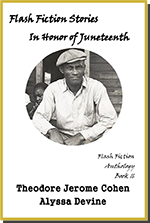
Flash Fiction Stories for Students and Teachers
Richard Wright said: "We black folk, our history, and our present being are a mirror of all the manifold experiences of America. What we want, what we represent, what we endure is what America is. If we black folk perish, America will perish." Lending credence to these words are many of the 16 stories here celebrating the creation of Juneteenth. The tales primarily were selected from among the 438 stories were found in Books 1 through 6, incl., of the authors' Creative Ink, Flashy Fiction anthologies. Included is an offering from Cohen’s second short-story anthology, The Road Less Taken – Book 2, as well as stories from Cohen's Mementos series of anthologies. Most of the stories in the instant volume are 250 words or fewer in length. They are best compared to a handful of peanuts or M&M's. Which is to say, they’re tiny, bite-sized morsels that won't let you stop with one! The longer tales were added for those who seek something more substantial with which to curl up on a long winter night or better, on a beach in the hot summer sun.
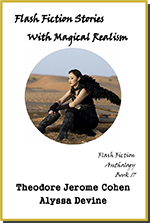
Flash Fiction Stories of Magical Realism
American actress Sherilyn Fenn said: "It's not sometimes realistic to think that something magical can happen, but I think I look for the magic." Many readers do as well. Here are 30 stories involving magical realism, tarot, and the paranormal. The tales primarily were selected from among the 438 stories found in Books 1 through 6, incl., of Cohen's Creative Ink, Flashy Fiction anthologies. Included, as well, are selected offerings from Cohen's two short-story anthologies, The Road Less Taken, as well as stories from Cohen's Mementos series of anthologies. Most of the stories in the instant volume are 250 words or fewer in length.

Flash Fiction Stories of Life and Death
Marcus Tullius Cicero wrote: "The life of the dead is placed in the memory of the living." Lending credence to these words are the 43 stories here about the lives and deaths of the subjects of these tales and the memories they left behind. The stories primarily were selected from among the 438 stories were found in Books 1 through 6, incl., of the authors' Creative Ink, Flashy Fiction anthologies. Included, as well, are selected offerings from Cohen's two short-story anthologies, The Road Less Taken, as well as stories from Cohen's Mementos series of anthologies. Most of the stories in the instant volume are 250 words or fewer in length.

More Flash Fiction Stories for Animal Lovers
Ruby Roth said: "We strive for a world where every earthling has the right to live and grow." Lending credence to these words are the 24 stories here about the animals with whom we share planet Earth, both domestic and wild. Some are the pets we love so dearly. A few of the tales here were selected from the last of the 438 stories found in Book 6 of the author's Creative Ink, Flashy Fiction series of flash fiction anthologies. Included as well is a selection from one of Cohen's short-story anthologies, The Road Less Taken - Book 1, and stories from Cohen's Mementos series of anthologies. Several of the stories in the instant volume are 250 words or fewer in length.
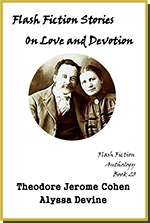
Flash Fiction Stories of Love and Devotion
Of all the literary classics I remember reading in my English classes at the University of Wisconsin-Madison in the late 1950s, To His Coy Mistress by Andrew Marvel is one of the poems that still stands out in my mind. And while the 45 stories here, which in one way or another relate to love and devotion, may not be as eloquently written as the works of Marvel, I hope you will find each one satisfying in its own right. The tales primarily were selected from among the 438 stories found in Books 1 through 6, incl., of my Creative Ink, Flashy Fiction anthologies. Included, as well, are selected offerings from my two short-story anthologies, The Road Less Taken, as well as stories from my Mementos series of anthologies. Many of the stories in the instant volume are 250 words or fewer in length.
In this volume, you'll find a story inspired by a 1973 PBS television show in which a steam bath is presented as the afterlife; here, however, the afterlife is a bowling alley overseen by the shoe attendant. In another story, we read a Civil War soldier's last letter home to his father, a letter filled with horrible descriptions of his imprisonment in Andersonville and his concern for the steamboat journey upon which he is about to embark. And not to leave you without something of the paranormal, there's even a story about the deep South and the superstitions that abound in Cajun Country. In short (pun intended), there is something in this book for almost every genre and taste.
In this volume, you'll find a story about a nun in Philadelphia who raises money for St. Vincent's Orphanage in a most unusual matter. In another story, we watch as two grown men are determined to find and visit a revered high school math teacher, only to learn one of life's saddest lessons: you can't go home again. And what are we to make of the story "Lost in the Library"? Which is to ask, what happened to the two young women who broke into the college library located several miles east of Holcomb, Kansas, while on a scavenger hunt sponsored by a sorority? In short (pun intended), there is something in this book for almost every genre and taste.
In this volume, you’ll find a story about a chance meeting between a young woman and an elderly gentleman in a New York City park, who has to remind her they had met many years earlier when she was very young. In another story, we listen to a mother calming her distraught daughter before bedtime and assuring her that her father will return as soon as he takes care of some "late-night business" downtown. And what are we to make of the story about an angel dressed completely in black and the helicopter crew member shot down during the invasion of Baghdad? Why isn't she helping him? In short (pun intended), there is something in this book for almost every genre and taste.
In this volume, you’ll find a story about an FBI agent who ended up accidentally, on purpose, dead. In another tale, we wait with Mildred, an elderly woman suffering from Alzheimer's, her son, and her daughter-in-law at Gate 6 in Philadelphia International Airport for Mildred's husband's plane to arrive. How long must they wait? And what are we to make of the true origins of the Broadway play West Side Story. You may be surprised to learn the production almost never happened. In short (pun intended), there is something in this book for almost every genre and taste.
In this volume, you'll find a story about a long funeral procession, comprising some 100 cars and motorcycles, the latter mostly big Harley-Davidson touring models. Who could their drivers possibly have been honoring? And what was the captain of the ocean-going freighter Duchess of Montrose, which was tied up in Porto Grande Bay, Cape Verde Islands, thinking as he watched a storm approaching that already had dropped his barometer to levels seen only in the strongest of hurricanes? In short (pun intended), there is something in this book for almost every genre and taste.
In this volume, you'll find a story about a trip down memory lane and, despite what is said, the ability to go home again. For those of us who seem to get caught up in the never-ending battle for their attention, leaving little time for family and friends, we offer the story "Time in a Bottle" as a reminder of what truly is important in life. And if you're a reader of police procedurals, this anthology includes eight (8) excerpts from the author’s Detective Louis Martelli, NYPD, Mystery/Thriller series (which can be read in any order). In short (pun intended), there is something in this book for almost every genre and taste.